In Part 1 of our definitive guide to the Great American Insurance Company (GAIC) ABAIS program, we established the foundation of the fortress: the D&O tower for your Board. We described it as the bedrock of bank protection—the primary shield for the institution’s leadership and balance sheet.
But a community bank is not just a boardroom; it is a complex operational engine.
You lend money, you manage trusts, and you advise customers. Every time a loan officer denies credit, a teller processes a wire, or a trust officer manages an estate, the bank creates operational exposure. This is the realm of Bankers Professional Liability, a risk category that a standard D&O policy was never designed to cover on its own.
This brings us to Part 2 of PlausTech’s 7-part series: Operational Defense.
For many community banks, the default strategy is to “bundle” these operational risks into the D&O policy using a powerful tool called the “Broad Form.” While efficient for smaller institutions, this bundling strategy can become a trap as a bank grows.
In this post, we will dissect the “Broad Form” architecture, expose the hidden “handcuff” endorsements that limit your payout, and explain when your bank should graduate from bundled endorsements to standalone towers.
Table of Contents
The Swiss Army Knife of Bankers Professional Liability: PD 1120
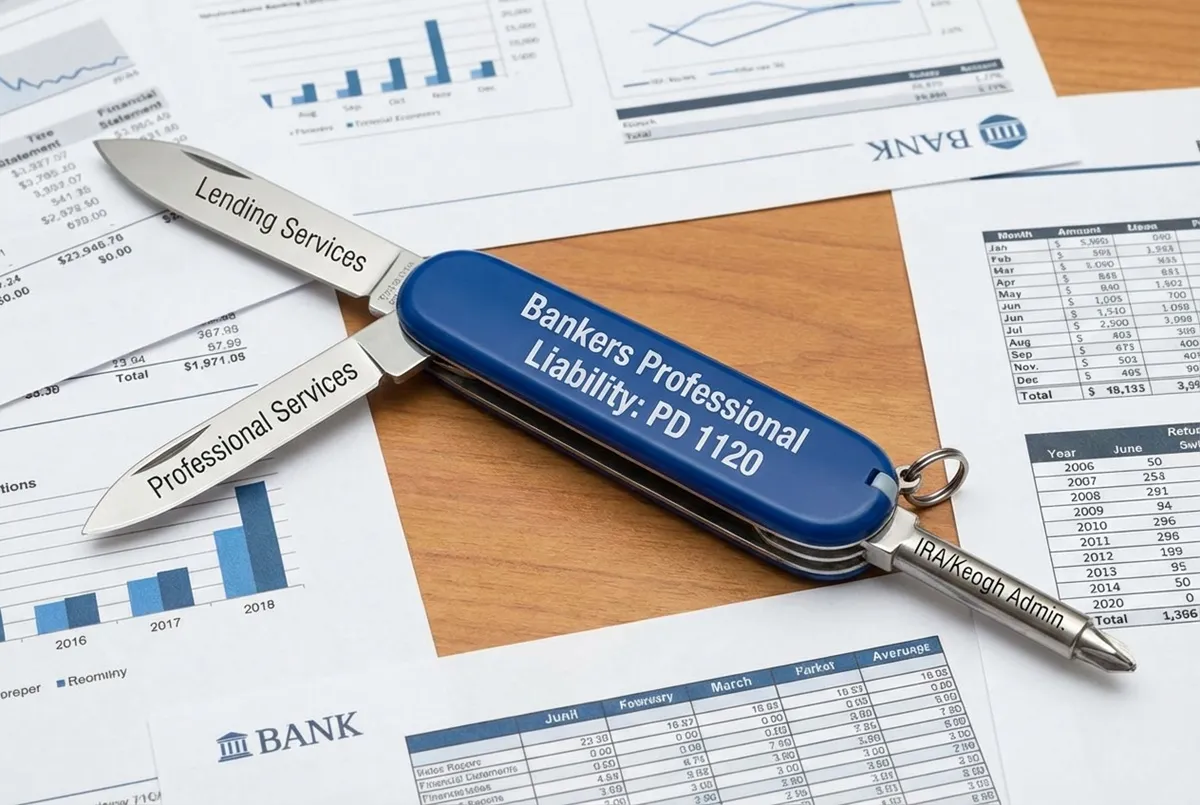
For the vast majority of community banks with assets under $1 billion, the Broad Form Company Liability (PD 1120) is arguably the most important endorsement in the entire policy.
It fundamentally transforms the D&O policy from a management liability contract into a hybrid Management & Bankers Professional Liability (MPL) policy. By attaching PD 1120, the policy expands “Entity Coverage” to include claims involving:
- Lending Services: Disputes over credit extensions, foreclosures, and loan servicing.
- Professional Services: A broad bucket that covers administration of deposits, wire transfers, and insurance services.
- IRA/Keogh Administration: Liability for acting as a custodian for retirement accounts.
The Strategic Advantage: The definition of “Professional Services” in PD 1120 is notably broad. It covers services performed for a fee or commission, but also covers instances where fees are waived for business reasons. This prevents the carrier from denying a claim simply because the bank offered a “free” service to a VIP client.
The “Handcuffs”: When Bundling Becomes a Liability
If the Broad Form is so comprehensive, why would a growing bank ever move away from it? The answer lies in two specific endorsements that act as “handcuffs” on your liability limits.
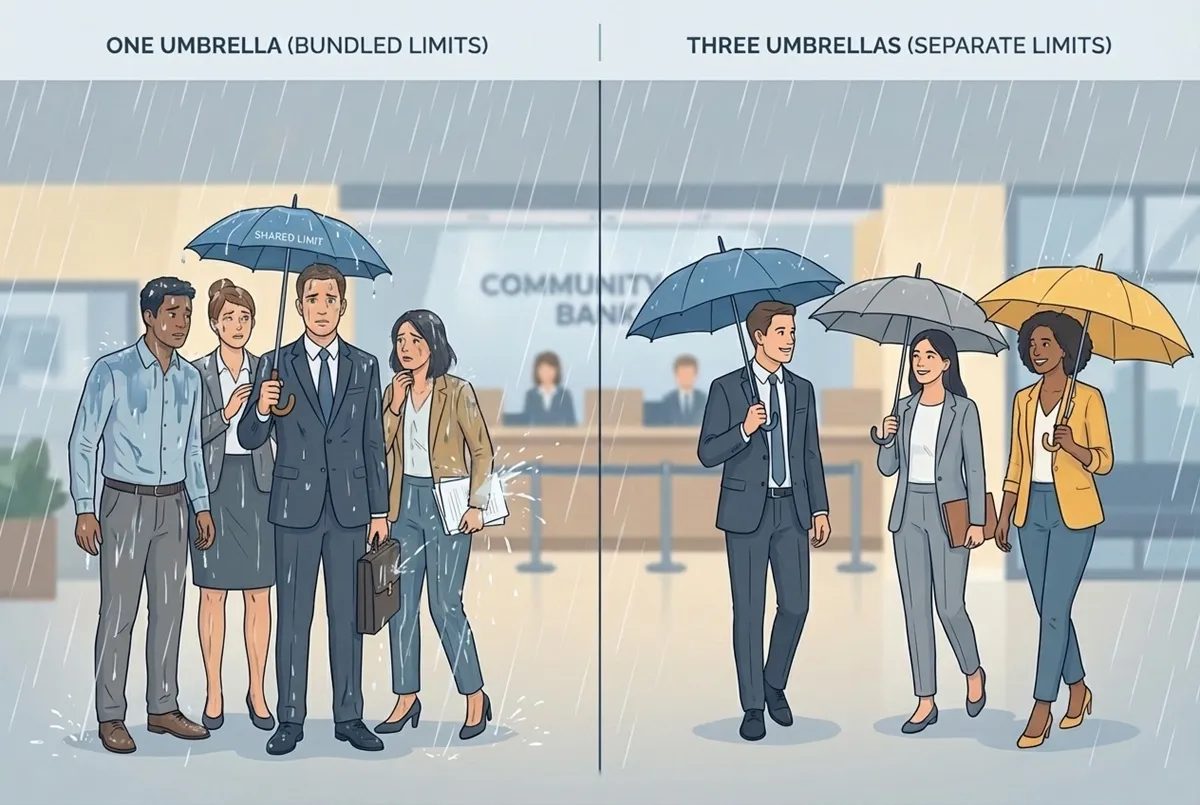
- PD 1136 (Combined Limit Endorsement): This form explicitly states that the Lender Liability Insuring Agreement and the Bankers Professional Liability Insuring Agreement share one aggregate limit.
- PD 1137 (Combined Limit Endorsement): This form ties the Professional Liability limit to the Trust Services Liability limit.
The “Tower Limit” Scenario
These forms create a dangerous “Tower Limit” issue.
Imagine your bank has a $3 million loss in your Trust Department due to a mishandled estate. Because of PD 1137, that $3 million payment erodes your aggregate limit.
The Consequence: You now have only $2 million left to defend your Board of Directors against a separate regulatory investigation or shareholder suit.
The Lesson: Bundling is cost-effective, but it is “cannibalistic.” As your bank scales toward $1 billion in assets, you must break these handcuffs. The strategic move is to strip these endorsements off and graduate to Standalone Policies (like the PT 1000 for Trust), decoupling your risks so a catastrophic error in one department does not leave the rest of the bank naked.
Lender Liability: The “Eviction” Fix & The Personal Shield
Lending is the core business of banking and the most frequent source of litigation. The GAIC program offers two primary ways to insure this, but they are not created equal.
1. The Scope of Coverage: PD 1140 vs. PD 1142
You want the Broad Form Lender Liability (PD 1140). This covers claims relating to “Lending Services” regardless of who brings them.
Avoid the narrower PD 1142, which restricts coverage to claims brought only by a “Borrower or Guarantor.” If a vendor, contractor, or other third party sues you regarding a loan project, PD 1142 could leave you bare.
2. The “Eviction” Fix (PD 4080)
Commercial foreclosures are messy. Borrowers rarely sue for just “breach of contract.” They sue for “wrongful eviction,” “libel,” “slander,” and “mental anguish.”
- The Risk: Standard D&O policies contain a “Bodily Injury/Personal Injury” exclusion that specifically excludes libel, slander, and eviction.
- The Solution: You must ensure your structure includes the Bodily/Personal Injury Exclusion Modification for Lender Liability (PD 4080).
This endorsement is a scalpel. It carves coverage back into the policy specifically for these emotional distress allegations. Without it, the carrier can deny the most contentious parts of a foreclosure lawsuit.
3. Protecting the Loan Officer (PD 1129)
Standard “Company Liability” endorsements often protect only the Entity (the Bank). But what if a specific Loan Officer or a Director on the Loan Committee is sued personally?
PD 1129 is the fix. It extends Insuring Agreements A (Side A) and B (Corporate Reimbursement) to the Broad Form module, ensuring your people are protected, not just your charter.
Trust Services: The Scalability Test
Trust Departments represent a unique fiduciary risk where the “Standard of Care” is higher than in commercial banking. How you structure this depends on your size.
Level 1: The Embedded Solution (PD 1160)
For banks with smaller, ancillary Trust Departments, the PD 1160 endorsement attaches Trust coverage to the D&O policy.
The Hidden Gem (PD 1165): Look for PD 1165. Standard E&O policies exclude “Failure to Maintain Insurance.”
- The Scenario: Your Trust officer manages a property and forgets to renew the fire insurance. The building burns down.
- The Fix: PD 1165 deletes this exclusion, forcing the GAIC policy to cover this specific administrative failure. Without it, the bank is on the hook for the full value of the property.
Level 2: The Standalone Solution (PT 1000)
This is the graduation point. If your Trust assets under management (AUM) constitute a significant portion of the bank’s value, or if you act as a Corporate Trustee, sharing a limit with the D&O is reckless.
The PT 1000 (Trust Services Liability Policy) is a completely separate chassis. It has its own limit of liability. A $5 million lawsuit against the Trust Department triggers this policy, leaving the D&O limit strictly for the protection of the Directors and Officers.
Summary: Designing Your Operational Defense
The difference between a “standard” renewal and a strategic risk architecture is knowing when to unbundle your coverage.
- Small Community Banks: Utilize PD 1120 (Broad Form) to gain efficiency, but ensure you have PD 4080 to cover foreclosure-related personal injury allegations.
- Growing Institutions: Audit your policy for the “Handcuffs” (PD 1136/1137). If your Trust or Lending volume is high, these shared limits are a threat to your Board’s protection.
- Complex Institutions: Move to the PT 1000 standalone policy to ring-fence fiduciary risk completely.
In Part 3, we will move to the “Human Element.” We will dismantle the dangerous trend of embedding Employment Practices Liability (EPL) into the D&O limit and explain why the “Separation of Powers”—moving to a Standalone PE 1000 policy—is critical for protecting your board from the modern workforce.
As this review shows, the difference between a generic policy and a robust defense is buried in the endorsements. You cannot afford to guess whether your bank is protected by a “must-have” gem or exposed by a “red flag” landmine.
This is the power of PlausTech.
Our CoverageXpert database has analyzed every one of these forms, enabling our free CoverageLocator tool to provide your bank with an instant, expert-level review of your Bankers Professional Liability and D&O architecture.
Stop wondering and start knowing. Don’t wait for a claim to discover what your policy is truly made of. Empower your bank with the clarity and confidence that only PlausTech can provide.