
In Part 1 of The 2026 SaaS Risk Stack, we broke down the “Minimum Viable Policies” you need to close deals and stay compliant—starting with the two policies enterprise procurement cares about most: Tech E&O and Cyber.
Now we’re going deeper, because founders keep running into the same trap:
- They buy Tech E&O like it’s the “product liability” of software.
- They buy Cyber like it’s “ransomware insurance.”
Then a real incident happens… and they realize the line between them is basically invisible. The distinction between the “Glitch” and the “Breach” is the core of the Tech E&O vs. Cyber insurance debate.
Table of Contents
The Worst Call Your CTO Can Make
It’s 9:12 am on a Tuesday.
Your CTO calls:
“AWS is down in our primary region. We’re offline. Our biggest customer is threatening to sue. Procurement is asking for our ‘cyber policy.’”
And now you’re staring at the question that creates insurance chaos: Is this a Cyber claim? Or an E&O claim?
If you get this wrong—or if your insurance program is structured incorrectly—you don’t just have downtime. You get insurance technical debt: delays, finger-pointing between carriers, uncovered losses, and legal bills that burn runway.
This post is your framework to avoid that.
The Mental Model: Two Failure Modes, One Reality
Here is the framework you need to understand:
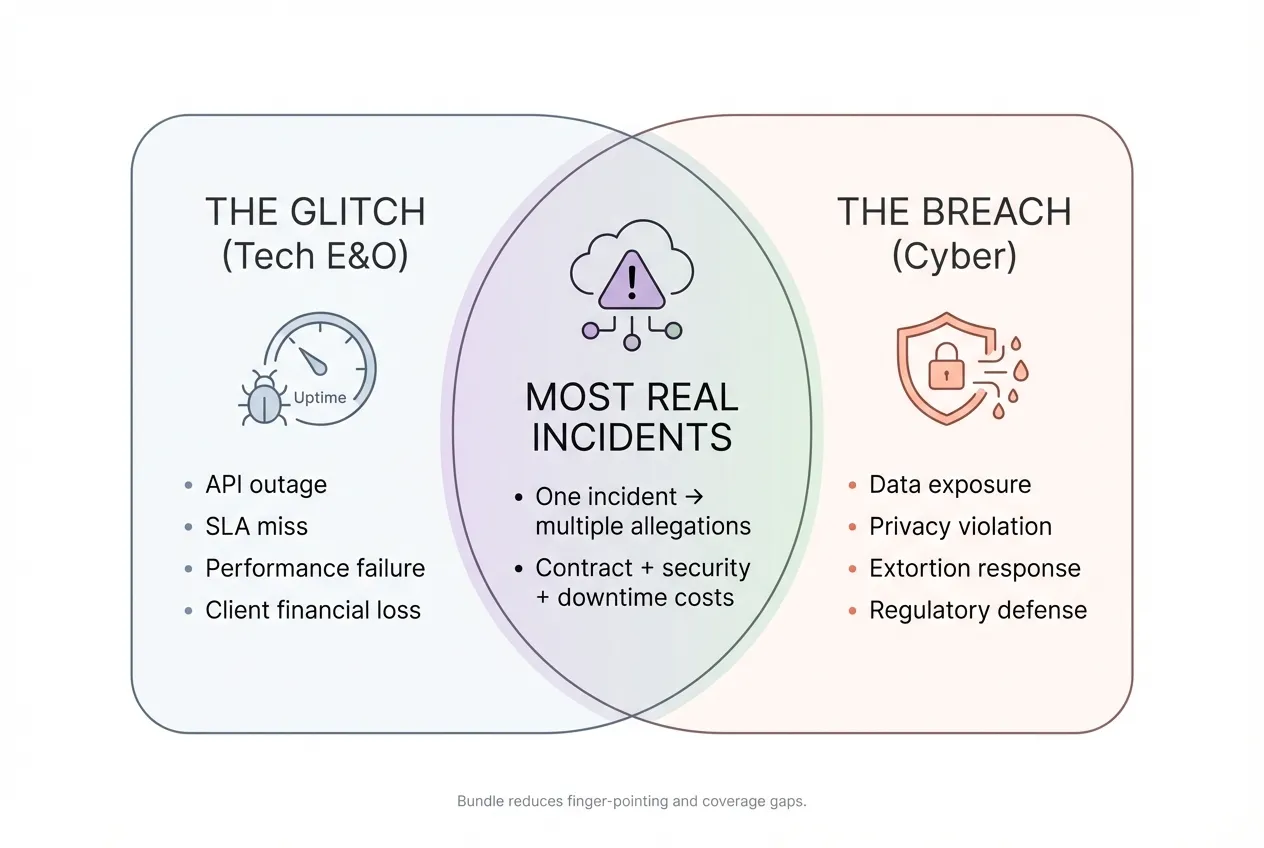
- The “Glitch” → Your product fails, underperforms, or causes client financial loss. (That’s usually Tech E&O).
- The “Breach” → Data exposure, privacy violation, security event, extortion, or regulatory action. (That’s usually Cyber).
But in SaaS, the messy truth is that most real incidents are both. A “glitch” becomes a breach. A “breach” gets discovered because of a glitch. A cloud outage triggers contractual penalties that look like E&O, while the costs to respond look like Cyber.
That’s why the decision you make isn’t just what policies you buy. It’s how you architect them.
The “Glitch”: Technology Errors and Omissions

The Trigger: “Your code failed.”
Technology Errors and Omissions coverage (Tech E&O) is designed to cover claims alleging:
- Your software didn’t perform as promised.
- Your service caused a client’s financial loss.
- Your deliverable or uptime commitment failed.
- Your product defect created downstream damages (lost revenue, operational disruption, etc.).
If your customer’s claim starts with “You promised…,” then your Tech E&O wording matters more than your limit.
The Problem: “Negligence” Isn’t the Same as “Performance Failure”
Founders assume E&O is a simple switch: software breaks → policy pays. But many policies draw a subtle line:
- Covered: Negligence in “professional services.”
- Excluded or Limited: Failure to perform the intended function, performance guarantees, or pure breach of contract.
SaaS disputes are almost always contractual. You don’t get sued in a vacuum. You get sued inside an MSA, an SLA, a DPA, and a procurement addendum someone redlined at 11:58 pm.
The Fix: You Need “Unintentional Breach of Contract” Coverage
If your software jams at 5,000 requests when you committed to 10,000… that’s not just a “bug.” That’s a performance failure that becomes a contract claim.
Your Tech E&O needs the right architecture—specifically:
- Contractual Liability / Unintentional Breach of Contract (so SLA-related claims aren’t dead on arrival).
- Strong language around performance commitments.
- Definitions of Technology Services that actually match what you do (API, hosted SaaS, professional services, integrations, etc.).
The Tech E&O Checklist: What to Ask For
When reviewing your policy, look for these specific items:
- Unintentional Breach of Contract / Contractual Liability: Confirm there’s a “carve-back” so the policy responds when the claim is contractual in nature.
- SLA / Performance Commitments: Make sure your wording doesn’t quietly treat performance commitments like an excluded warranty.
- Definition of “Technology Services”: Does it include your actual delivery model (SaaS, API, hosted services, managed services, implementation)?
- Failure to Perform / Intended Function Exclusions: If present, can they be removed or narrowed so you’re not buying a policy that excludes the very thing you sell?
The “Breach”: Cyber Insurance System Failure & Hacks

The Trigger: “Data theft or privacy violation.”
Cyber insurance typically covers costs like:
- Breach response (forensics, legal, notification).
- Extortion/Ransomware response.
- Privacy regulatory defense.
- Third-party privacy liability (lawsuits alleging data misuse).
But the focus here is a different Cyber trap.
The Misconception: “Cyber triggers only on hacks.”
Many founders hear “Cyber” and think: criminals broke in → cyber policy pays.
But what if AWS goes down because of a power issue? What if your cloud database provider has a bad day? What if a misconfiguration takes you offline?
That’s not always a “security breach.” And if your Cyber policy is written narrowly—only triggered by a defined “data breach” or “security failure”—you can end up uninsured for one of the most common SaaS realities: System Failure and Dependent Outages.
Founders often think of this as SaaS downtime insurance, covering you when your vendors go dark. If a core provider outage takes you down, the coverage you should care about is:
- Dependent Business Interruption (DBI): Coverage for loss/extra expense due to outages at vendors you depend on (think cloud providers, CDN, critical SaaS infrastructure).
- System Failure Coverage: Coverage for non-malicious outages, not just attacks.
The Cyber Checklist: What to Ask For
Ensure your Cyber policy handles the “quiet” outages, not just the loud hacks:
- System Failure / Non-Malicious Outage: Confirm the policy covers outages that aren’t caused by an attacker.
- Dependent Business Interruption: Make sure it explicitly contemplates your reliance on third-party infrastructure (effective SaaS downtime insurance).
- Privacy/Regulatory Defense: Confirm coverage for privacy regulatory actions and defense costs.
- Exclusions Stress Test: Look hard for exclusions that map to your real stack (tracking, analytics, session replay tools, vendor dependencies, etc.).
The Solution: The Tech E&O Cyber Bundle
The Question: “Should we buy separate policies or settle the Tech E&O vs. Cyber insurance question with a bundle?”
The Answer: For a SaaS company, usually No—don’t split them. Bundle them.
Here’s why.
The SaaS Reality: The Boundary Between “Bug” and “Breach” Is Invisible
In SaaS, a single incident can create multiple allegations:
- “Your API outage breached the SLA.” (E&O)
- “Your downtime caused our lost revenue.” (E&O)
- “You failed to maintain secure systems.” (Cyber)
- “You exposed personal data.” (Cyber)
- “You misrepresented security / uptime in your contract.” (E&O + Cyber)
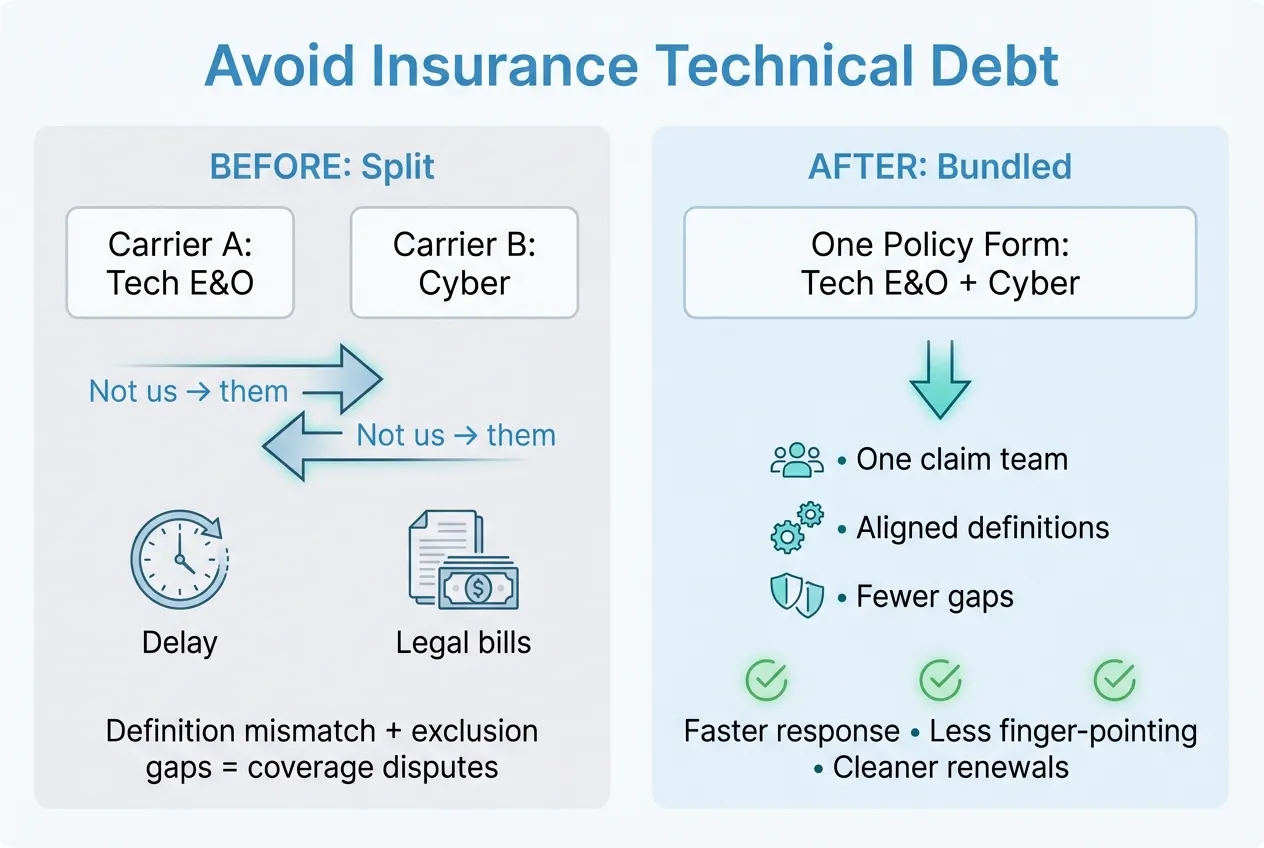
Now imagine you bought Tech E&O from Carrier A and Cyber from Carrier B. A real-world claim hits. Both carriers see the same loss and think:
- Carrier A: “This is a cyber/privacy event—go to their policy.”
- Carrier B: “This is professional services / contract damages—go to their policy.”
Meanwhile, you’re paying counsel, your customer is escalating, your board is asking for updates, and your cash is bleeding. This is the insurance version of distributed systems debugging: everyone points at someone else’s service.
The “Tech Package” Form: One Policy, One Source of Truth
When you buy a Tech E&O cyber bundle (often called a combined Tech Package form), you’re reducing friction in four critical ways:
- One claim team, one clock, fewer delays: You don’t want two carriers arguing over who should pay while your legal bills stack up.
- Aligned definitions: Words like “wrongful act,” “security failure,” “technology services,” and “privacy event” matter. A Tech E&O cyber bundle improves the odds the definitions work together.
- Fewer gaps between exclusions: Standalone policies can create dead zones—where each policy excludes something the other one assumes it covers.
- Cleaner procurement and renewals: Enterprise customers don’t care about your internal insurance architecture. They care whether you can respond. A tech package is generally easier to present, explain, and maintain.
The Insurance Technical Debt You Want to Avoid
If you’re a SaaS founder, you already know what technical debt feels like: slow releases, surprise failures, and expensive fixes at the worst time.
Insurance technical debt looks like:
- Buying “checkbox coverage” that doesn’t match your contracts.
- Accepting exclusions you don’t understand.
- Splitting policies in ways that create disputes.
- Finding out at claim time that “intended function” isn’t covered.
- Assuming cyber covers outages when it only covers hacks.
The entire point of a well-structured Tech E&O cyber bundle is to reduce that debt before it compounds.
The Bottom Line
If your company sells uptime, performance, security, availability, data handling, and privacy trust… then you don’t just need policies. You need coverage architecture.
Final Founder Takeaway: If you rely on 99.99% uptime, you need one policy that covers both the Glitch and the Breach—and you should buy it as a combined Tech E&O vs Cyber insurance package, not two disconnected standalone policies.
How PlausTech, CoverageXpert & CoverageLocator Can Help
PlausTech is an AI-first insurance brokerage built for SaaS and tech companies that can’t afford coverage gaps hiding in fine print.
We’re powered by the CoverageXpert database, which benchmarks policy forms and endorsements—so you’re not guessing whether your Technology E&O and Cyber coverage actually matches the risks you take in your MSAs, SLAs, and data obligations.
With CoverageLocator technology, we stress test your current program, uncover hidden gaps (like failure-to-perform language, weak contract carve-backs, missing dependent business interruption, or modern privacy exclusions), and recommend the endorsements that transform adequate coverage into best-in-class protection.
And we don’t just send a PDF. Using cutting-edge tech, we ensure:
- No gaps are missed.
- Your coverage is aligned with your goals.
- You can see everything that changed in your program with crystal clear clarity.
Ready for a Free, No-Obligation Tech E&O + Cyber Policy Review?
Protect your revenue. Protect your customers. Protect your runway.