You’ve architected the stack. Now, who are you buying it from?
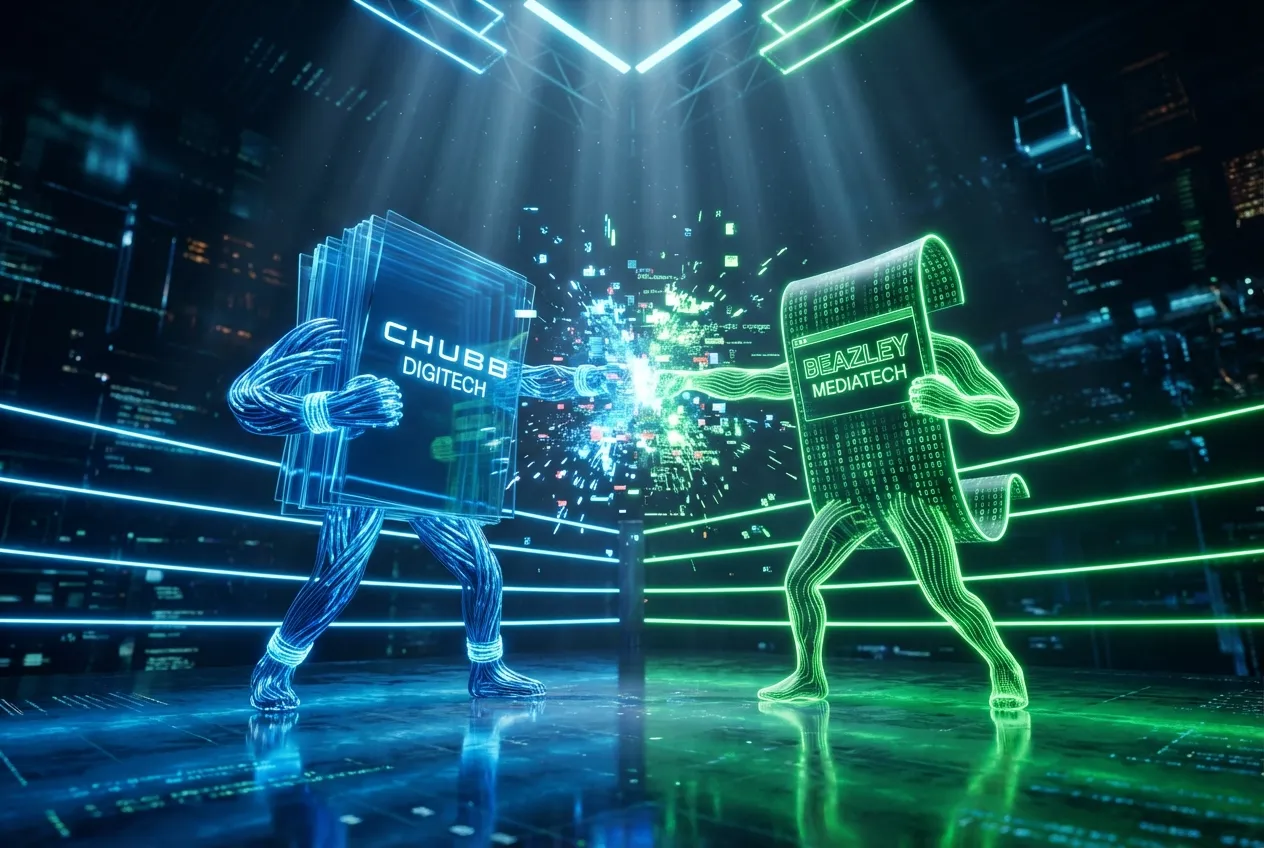
In this Chubb DigiTech vs Beazley MediaTech showdown, we determine who really wins for your specific revenue model.
In our SaaS Insurance Series, we’ve already covered the Minimum Viable Policies to get past procurement (Part 1) and the Mental Model for bundling Tech E&O with Cyber (Part 2).
Now, we execute.
Many founders treat insurance as a commodity, assuming a $5M limit from Carrier A is identical to Carrier B. It isn’t. On a Certificate of Insurance, these policies look the same. But when AWS goes down or a pixel lawsuit hits, the fine print creates two very different outcomes.
To prove it, we are performing the ultimate SaaS insurance carrier comparison to see who actually pays.
Table of Contents
TL;DR
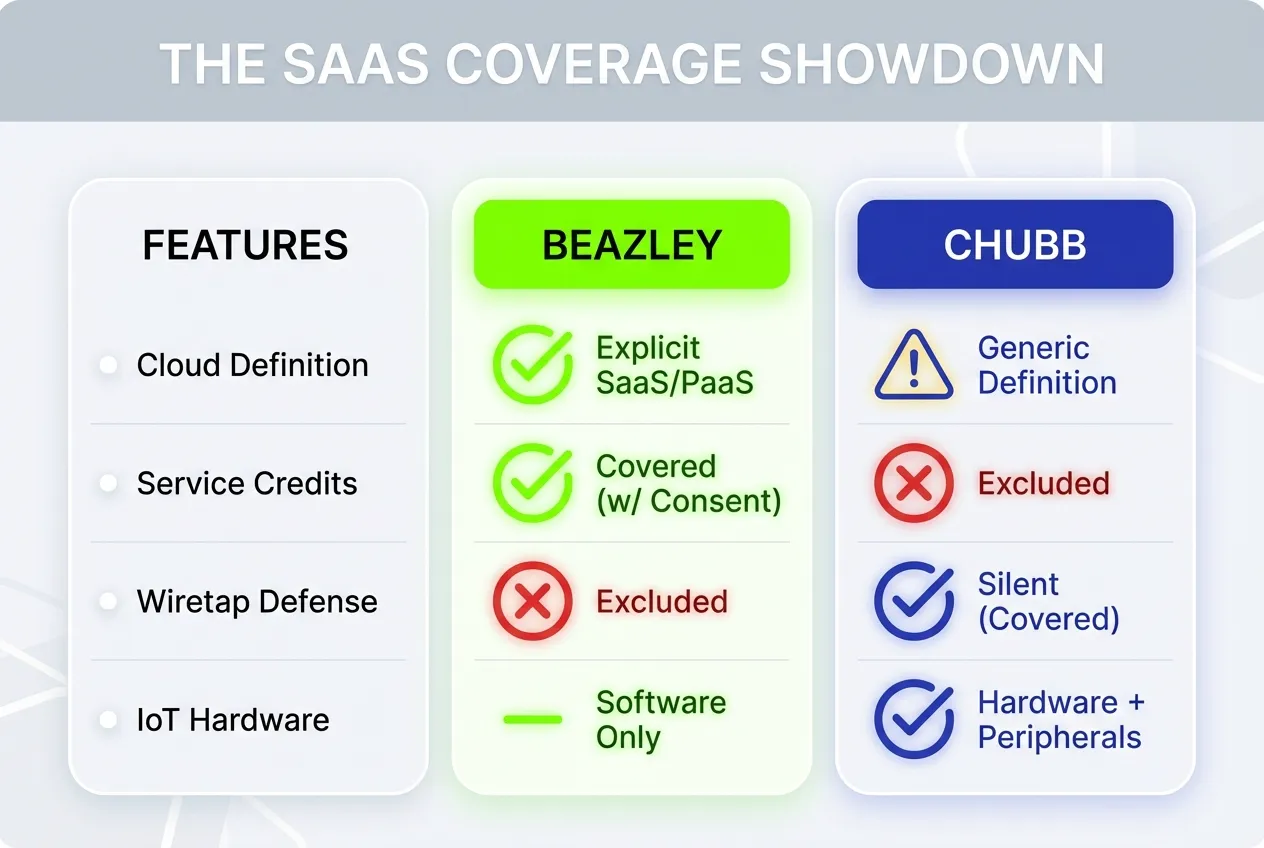
- Beazley wins on modern cloud definitions and “service credit” logic—making it the superior choice for pure B2B SaaS, provided you get Underwriters’ consent for credits.
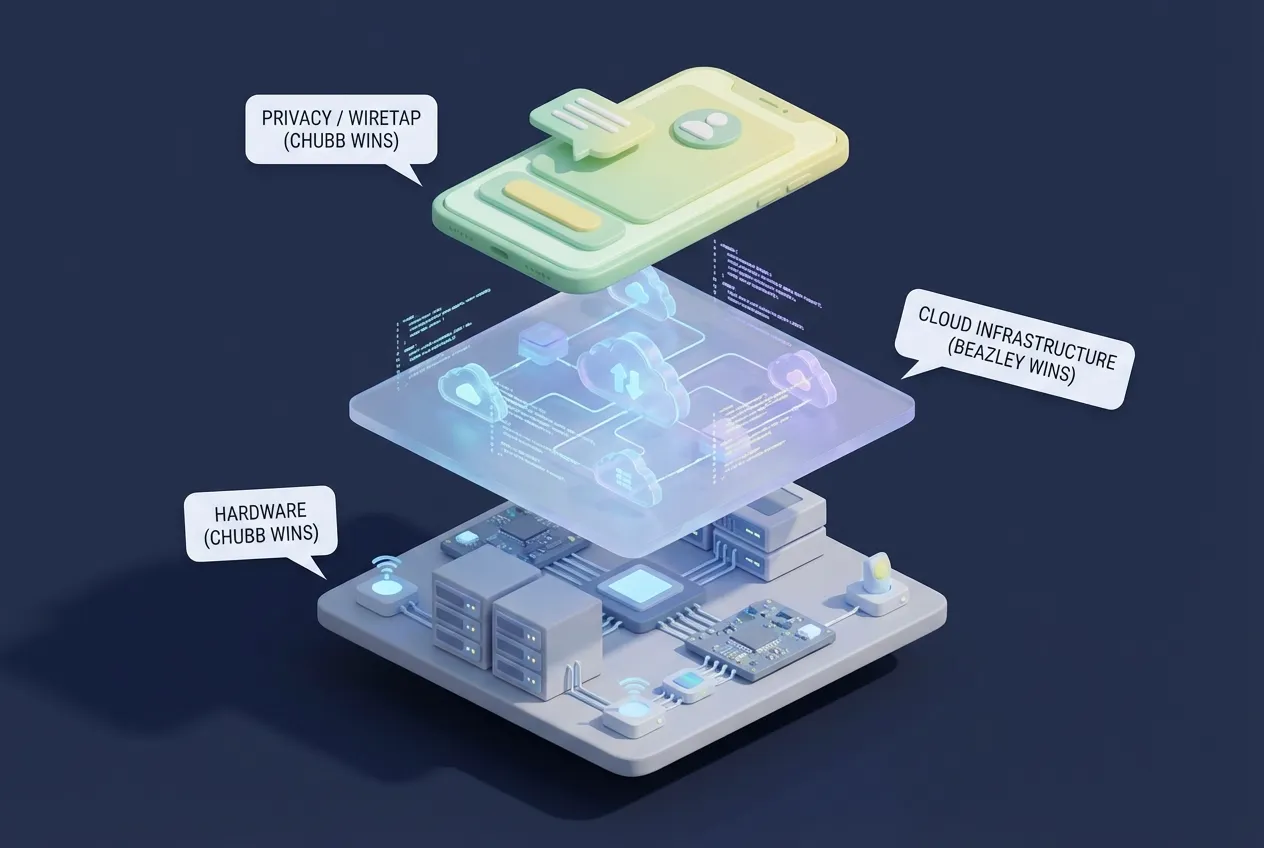
- Chubb wins on privacy defense (no express “wiretap” exclusion) and physical IoT products (explicit “peripherals” coverage).
- The “Sole Benefit” clause in Chubb’s legacy language creates friction. While Chubb solves this with a “Shared Computer System” definition, you must ensure your policy triggers that definition rather than the standard “Insured’s Computer System.”
The Ground Rules
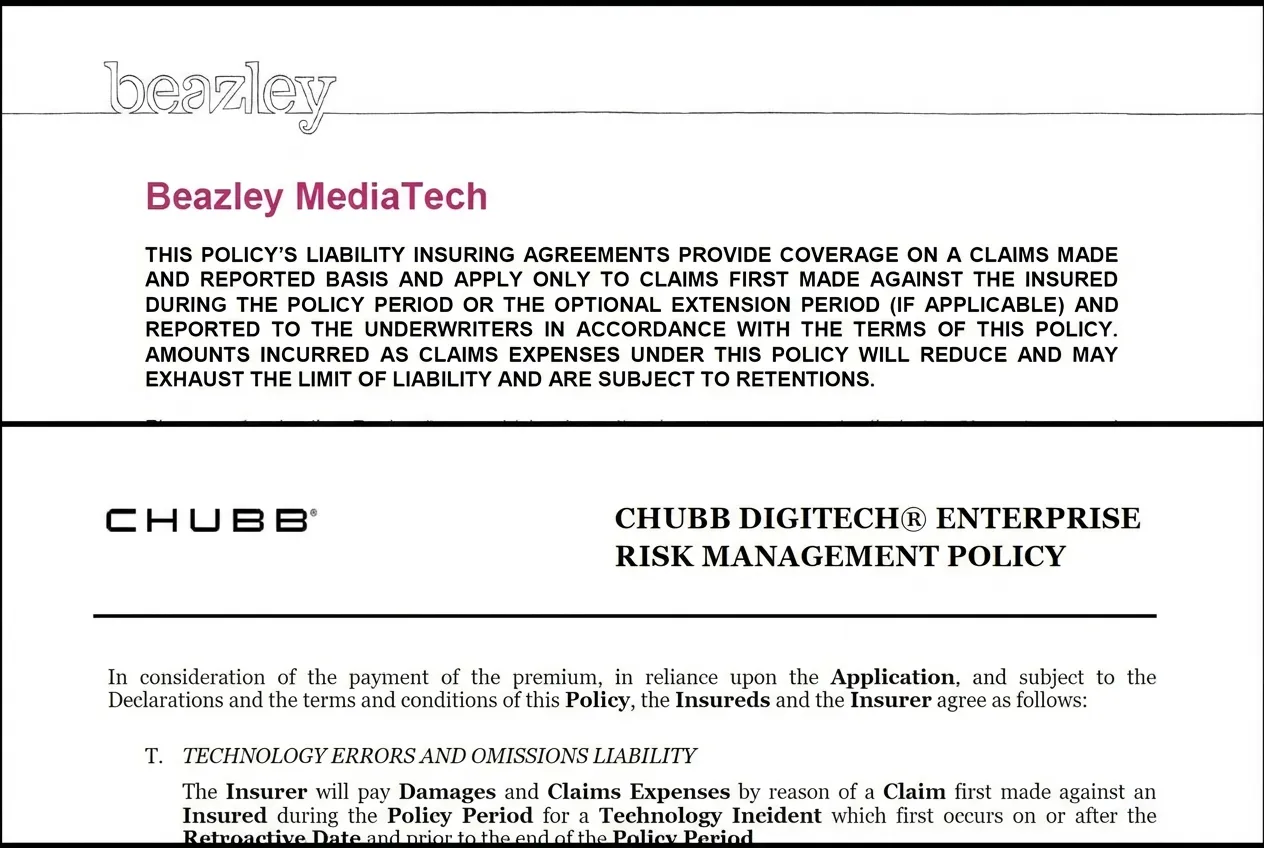
We’re not testing who has the prettier marketing brochure. We’re stress-testing how the policy language behaves when you hit real SaaS failure modes. We are looking at Chubb DigiTech (Enterprise Risk Management Policy) vs Beazley MediaTech (Media, Tech, Data & Network Liability) to see who pays when:
- AWS goes down (multi-tenant cloud dependency).
- A “glitch” causes an SLA miss + contract claim.
- Tracking pixel / chatbot “wiretap” allegations arise.
- Hardware + software (IoT) breaks.
Here is the fine print showdown.
1. The “What is Cloud?” Test
The Scenario: You need the policy to actually cover the modern tech stack you sell.
Beazley is explicit. Their definition of Tech Services expressly includes cloud models by name: “software as a service (SaaS), platform as a service (PaaS), infrastructure as a service (IaaS), [and] network as a service (NaaS).”
That’s founder-friendly. If you sell SaaS, the policy uses the same words your customers, investors, and contracts use.
Chubb is broader, but more generic. Technology Services is defined with a long list that includes “hosting,” but doesn’t name SaaS/PaaS/IaaS in that definition. Fairness note: Chubb does explicitly reference “infrastructure-as-a-service” in their Shared Computer System definition (for Cyber/Business Interruption), but for the definition of your services, Beazley is more precise.
Winner: Beazley (Clean SaaS/cloud alignment).
2. The “Sole Benefit” Trap (Multi-Tenant Infrastructure)
The Scenario: You rely on AWS or Azure. A claim arises involving that infrastructure.
Chubb’s “Insured’s Computer System” definition contains a classic trap: it includes third-party systems only if they are “operated solely for the benefit of an Insured by a third party under written contract…”
Why founders should care: AWS is not operated “solely for the benefit” of your company. It’s multi-tenant. Chubb addresses this by having a separate Shared Computer System definition for cloud providers. The catch? You need to make sure the specific Insuring Agreement you are claiming against points to “Shared” (e.g., Insuring Agreement B.2 Contingent Business Interruption) rather than just “Insured’s System.”
Beazley leans into the reality of dependency without the extra navigation. They define Dependent Business as any entity (not part of your org) providing necessary services pursuant to a written contract, and define Dependent System Failure as an interruption of systems operated by that dependent business. This tracks with how the SaaS supply chain (AWS/Cloudflare/Stripe) actually works.
Winner: Beazley (Cleaner fit for multi-tenant cloud reliance).
3. The AWS Outage “Gotcha” (Dependent Business Interruption)
The Scenario: AWS goes down due to a config error (non-malicious). Your site is dark. You lose revenue.
Chubb’s Business Interruption trigger is tied to a “Cyber Incident,” which is defined as an “Interruption in Service” caused by a Malicious Computer Act.
Translation: If AWS goes down because of a non-malicious event (human error, internal failure), Chubb’s BI language is a harder fit because there was no “malicious or fraudulent” conduct involved in the outage.
Beazley distinguishes between your system failure vs. your provider’s failure. While they exclude third-party systems from your own “System Failure,” they push that exposure into Dependent Business Loss. This covers “unintentional and unplanned interruption” of a Dependent Business (under written contract). It doesn’t require a hack to trigger coverage—though standard Waiting Periods will apply.
Beazley distinguishes between your system failure vs. your provider’s failure. While they exclude third-party systems from your own “System Failure,” they push that exposure into Dependent Business Interruption coverage (often categorized under Dependent Business Loss).
Winner: Beazley (Structurally clearer for non-malicious AWS outages).
4. The “Glitch” & Tech E&O Breach of Contract

The Scenario: Your release introduces a bug. You miss your SLA. The customer sues for breach of contract (“You promised 99.9% uptime”).
Chubb excludes claims for breach of contract, with a carve-back for “unintentional failure to perform Technology Services… with a reasonable standard of care.”
The risk: This anchors coverage to a negligence standard. If a plaintiff pleads a pure contract theory (“You promised X, you delivered Y”), Chubb has room to argue the carve-back doesn’t apply because you didn’t necessarily fail a “standard of care” (negligence)—you just failed a contract term. Note that this carve-back applies specifically to Insuring Agreement T.
Beazley creates a much wider lane Tech E&O breach of contract. Their contractual exclusion explicitly “will not apply to… the obligation to perform Professional Services or Tech Services” (regarding parts 1 and 3 of the liability agreement).
Even better, Beazley bakes contract breach right into the covered wrongful act: “Tech & Professional Services Wrongful Act means… unintentional breach of a contractual obligation.”
Winner: Beazley (Less “you must plead negligence” energy).
5. The CFO Question: Service Credits
The Scenario: To appease the angry customer from the scenario above, you have to issue service credits.
Chubb is strict. Damages “shall not include… consideration owed or paid… including… return of any payment, charges, or fees.” If your remedy is “credit the invoice,” Chubb generally won’t pay it.
Beazley is unusually practical. Their definition of Damages states: “With the prior written consent of the Underwriters, Damages also include the direct net cost of providing… future service credits… in lieu of a monetary payment.”
Winner: Beazley (They understand SaaS commercial remedies—just get that consent in writing).
6. The Privacy Trap and Wiretap Exclusion
The Scenario: A class action alleges your chatbot or marketing pixel “intercepted communications” (CIPA / wiretap-style allegations).
Beazley hits a hard stop here. They have a “Distribution of Information” exclusion that specifically creates a wiretap exclusion for Loss arising out of “…wire tapping, audio or video recording…”
While there is a small defense-only giveback for unlawful audio/video recording, there is no parallel carve-back for “wire tapping.” If the complaint uses the word “wiretap” (which CIPA/pixel complaints almost always do), Beazley creates a massive coverage wall.
Chubb is safer here. They do not have an express wiretap exclusion in the same way. Their Cyber Incident trigger includes “unintentional wrongful collection of Protected Information.” While Chubb does exclude “Intentional Unlawful Collection,” that often requires proving intent, whereas Beazley’s exclusion can be triggered simply by the nature of the “wire tapping” allegation itself.
Winner: Chubb (Beazley’s express exclusion is dangerous for B2C platforms).
7. Hardware & IoT Coverage
The Scenario: You sell sensors/devices + embedded software. A device fails and causes business loss.
Beazley covers “Tech Products,” defined as “a computer or telecommunications hardware or software product, or related electronic product.” This is good, but can leave some gray area on non-computing peripherals.
Chubb is explicitly built for physical tech. Their “Technology Products” definition includes “hardware, equipment, parts, or peripherals.” If you ship gateways, sensors, or accessories, this language provides zero wiggle room for the carrier to deny coverage based on “parts” vs. “products.”
Winner: Chubb (Clearer IoT/physical product fit).
Chubb DigiTech vs Beazley MediaTech: Who Wins for Which Buyer?
Profile A: Pure B2B SaaS
(High uptime needs, heavy AWS reliance, standard SLAs)
Winner: Beazley MediaTech
Why: Their language reads like it was written for your revenue model. They understand SaaS/Cloud definitions, they cover the “dependent” nature of AWS (under written contract), and they are willing to cover service credits (with prior written consent).
Profile B: Hardware / IoT Startup
(Physical sensors + software)
Winner: Chubb DigiTech
Why: The “Technology Products” definition is explicitly inclusive of “hardware, equipment, parts, or peripherals.” The policy is explicitly designed to handle physical tech failure points.
Profile C: B2C Digital Platform
(Pixels, chatbots, high privacy risk)
Winner: Chubb DigiTech
Why: Beazley’s express wiretap exclusion is a trap door for modern CIPA/pixel litigation. Chubb’s language (via Cyber Incident or Media Incident) is harder to break when facing privacy class actions that allege “interception.”
How PlausTech, CoverageXpert & CoverageLocator Can Help
The analysis above isn’t opinion—it’s data.
PlausTech is the only broker powered by the CoverageXpert database, which benchmarks every admitted policy form and endorsement sold in the United States. We know exactly where Chubb’s “Shared Computer System” clause hides and where Beazley’s exclusions kicks in.
With our CoverageLocator technology, we stress test your current program against these exact scenarios. We don’t just guess which carrier is better for you; we prove it.
- We benchmark your stack: AWS reliance vs. Pixel exposure.
- We uncover the gaps: Service credits, Tech E&O breach of contract triggers, and definitions.
- We show you the win: Crystal clear clarity on why one form beats the other for your specific business.
Ready for a Free, No-Obligation Policy Review?
Don’t let a generic broker sell you the wrong paper.