In Parts 1 through 5 of our definitive guide to the Great American Insurance Company (GAIC) ABAIS program, we constructed a fortress. We built the D&O tower for your Board, the Professional Liability tower for your lenders, the EPL tower for your workforce, the Cyber/Bond alliance to guard the vault, and established the Claim Protocols to defend it.
But a fortress is only as strong as its weakest wall.
An insurance policy is defined as much by what it excludes as what it covers. While the declarations page promises millions of dollars in protection, bank insurance exclusions—often buried deep in the back of the policy—contain the fine print that can render those millions inaccessible.
This brings us to Part 6 of PlausTech’s 7-part series: The Minefield.
Most directors assume that if they buy a “D&O Policy,” they are covered for “Wrongful Acts.” They are wrong. A single “laser exclusion”—often hiding behind an innocent-looking 4-digit form number—can reverse the burden of proof, remove coverage for the bank’s primary business activities, or leave the Directors defenseless in a regulatory crisis.
In this post, we are applying the CoverageXpert forensic lens to hunt for the worst (“-5”) scores. These are the lethal clauses that you must identify and remove to ensure your bank’s survival.
Table of Contents
1. The “Bank Killer”: Classified Loan Exclusion (PD 3000)
The Trap:
Community banks exist to lend money. Consequently, the majority of D&O claims arise when loans go bad. Yet, form PD 3000 is specifically designed to hollow out your coverage exactly when you need it most via the Classified Loan Exclusion.
The Forensic Analysis:
- The Base Policy (PD 1000): The base definition of “Loss” explicitly excludes the unpaid principal of the loan itself (you can’t insure against bad debt). However, Insuring Agreement A does cover the “Loss” resulting from liability claims—meaning it pays for your defense and settlements if you are sued for lending decisions.
- The Modification (PD 3000): This endorsement amends Section V. It states the insurer will not be liable for Loss or Defense Costs regarding any loan that was “Classified” (substandard, doubtful, or loss) or “Past Due” (90+ days) at the inception of the policy.
The Reality:
Litigation rarely happens when a loan is performing. It happens during credit downturns when portfolios are stressed. If your policy includes a Classified Loan Exclusion, the insurer can look back at your loan tapes, identify that the problematic credit was already distressed when you renewed the policy, and deny the claim entirely. Unlike other exclusions that might preserve defense costs, PD 3000 typically eliminates both the indemnity and the legal fees.
2. The “Silent Killer”: The Defense Trigger (PD 3040)
The Trap:
In the American legal system, you are innocent until proven guilty. In the insurance world, form PD 3040 (on the D&O side) and PC 3000 (on the Cyber side) can reverse that presumption.
The Forensic Analysis:
- The Base Policy: The standard “Fraud/Violation of Law Exclusion” contains a vital safety net: it excludes Loss other than Defense Costs. Furthermore, it states the insurer cannot deny coverage until a “final non-appealable adjudication” establishes the fraud. This is the Gold Standard.
- The Modification: These endorsements replace “final non-appealable adjudication” with the phrase “in fact.” More dangerously, they remove the carve-back for Defense Costs.

The Reality:
This is worse than just a lowered burden of proof. By removing the “other than Defense Costs” language found in the base form, the insurer isn’t just reserving the right to deny the settlement; they are cutting off the oxygen to your defense team. An insurance adjuster can review the evidence, determine “in fact” that a dishonest act occurred, and cut off your legal funding immediately.
3. The “Nuclear Option”: Regulatory Exclusion (PD 3200)
The Trap:
For a bank director, the ultimate nightmare is bank failure followed by an FDIC lawsuit. The Regulatory Exclusion determines whether your personal assets are safe in this worst-case scenario.
The Forensic Analysis:
- The Base Policy (PD 1000): There is no absolute Regulatory Exclusion in the base policy. In fact, the “Insured vs. Insured” exclusion explicitly allows claims brought by receivers like the FDIC Professional Liability Program.
- The Modification (PD 3200): This endorsement adds a new exclusion for any Claim brought by “any Agency.” Crucially, the text states: “The Insurer shall not be liable to make any payment for Loss…”
The Reality:
In the base policy definitions, “Loss” includes Defense Costs. By excluding “Loss” generally in PD 3200, the insurer excludes both the settlement and the lawyer fees. If your bank fails and the FDIC sues you, this endorsement ensures the policy pays $0.
The Fix:
Negotiate for PD 3180 (Limited Regulatory Exclusion). It explicitly carves back coverage for Defense Costs, ensuring you have the funds to fight the regulator.
4. The “Tech E&O” Trap: Professional Services Exclusion (PC 3100)
The Trap:
In the digital age, is a failed wire transfer a “Cyber Event” or a “Banking Error”? The Professional Services Exclusion often determines the answer.
The Forensic Analysis:
- The Base Policy (PC 1000): Insuring Agreement C covers “Wrongful Cyber Banking Services,” including failure to provide access to internet banking.
- The Modification (PC 3100): This endorsement adds a Professional Services Exclusion. It typically includes a schedule where “Electronic Data Processing Services” is checked off.
The Reality:
This creates a massive definition war. The base policy defines a “Customer” as someone receiving professional services, but PC 3100 explicitly excludes claims arising out of those services.
- Scenario: Your online banking platform glitches, causing duplicate transfers.
- The Denial: The Cyber carrier denies the claim citing PC 3100, arguing it was a “Professional Service” failure. Meanwhile, your Bankers Professional Liability carrier might deny it as a “System Failure.”
5. The “Reg E” Trap: Funds Transfer Exclusion (PC 3180)
The Trap:
Consumer cyber fraud—unauthorized Zelle, Venmo, or ACH transfers—is a daily headache for community banks.
The Forensic Analysis:
- The Base Policy (PC 1000): Section I(B) explicitly grants coverage for “Electronic Funds Transfer Liability” (provided there is a written agreement with the customer).
- The Modification (PC 3180): This endorsement amends Section V to add the Funds Transfer Exclusion. It explicitly states the insurer will not pay for Loss involving “Electronic Funds Transfer Acts.”
The Reality:
PC 3180 effectively deletes Insuring Agreement I(B). Even if you have the required written agreements in place, this endorsement overrides them. It forces the bank to self-insure “Reg E” type losses. Since these are among the most frequent consumer claims a bank faces, this endorsement renders the Cyber policy useless for one of your highest-frequency risks.
How to Spot Hidden Bank Insurance Exclusions
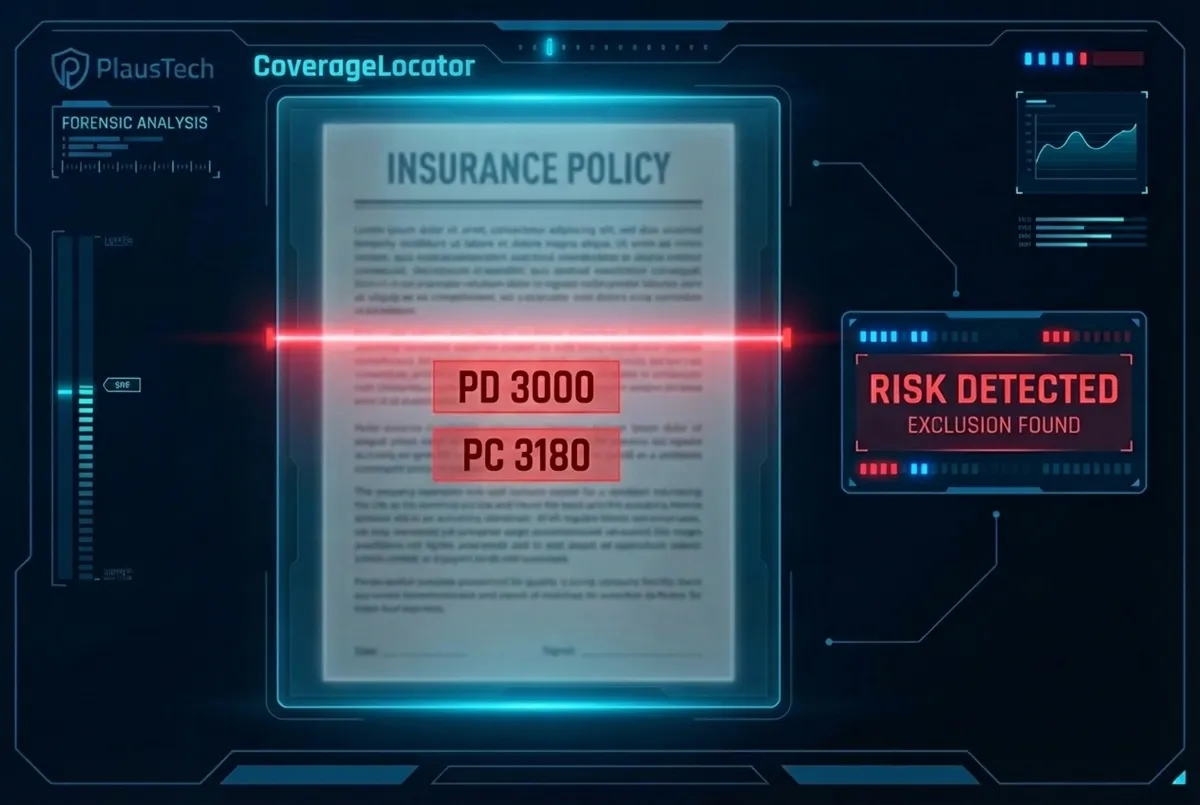
Don’t walk the minefield blindfolded. The problem with legacy insurance reviews is that these bank insurance exclusions are hidden in the back of 100+ page PDF documents. To the untrained eye, PD 3180 (The “Good” Regulatory Exclusion) looks identical to PD 3200 (The “Fatal” Regulatory Exclusion).
This is the power of PlausTech.
We don’t rely on memory or manual reviews. We rely on CoverageXpert, our proprietary database containing the full text, indexing, and scoring logic for over 450,000 commercial insurance forms. CoverageXpert reads the difference between “final adjudication” and “in fact.” It spots when an endorsement like PC 3000 silently deletes the Defense Cost carve-back.
We have opened this intelligence to you via CoverageLocator.
- It ingests your policy file.
- It cross-references your specific endorsements against the CoverageXpert knowledge base.
- It instantly flags “Red Flag” exclusions like the Classified Loan Exclusion or Funds Transfer Exclusion that a human might miss.
You have the policy data. We have the intelligence. Don’t wait for a claim denial to find out where the landmines are buried.
In the final installment, Part 7: The Crown Jewels, we will move from defense to offense. We will reveal the 5 “Elite Endorsements” that turn a standard policy into a superior asset.