The headlines this week serve as a stark reminder of the interconnected nature of modern business. Cloud networking giant Cloudflare announced it was one of over 700 companies impacted by a massive supply-chain attack targeting businesses through their Salesforce integrations. The breach originated from a compromised third-party marketing tool, SalesLoft/Drift, allowing attackers to steal customer data from the Salesforce instances of major companies, including Palo Alto Networks and Zscaler. This high-profile incident has immediately pushed the topic of supply chain attack insurance to the forefront, as companies question whether their current cyber policies would actually respond to such a third-party failure.
Free Resource: This article analyzes critical insurance forms in detail. As you read, you’ll find links to download free, ready-to-use PDF versions of each policy document, complete with our custom summary cover page.
To be clear, neither Salesforce’s core platform nor Cloudflare’s own corporate network was breached. Instead, attackers exploited a trusted connection, using stolen credentials from the third-party app to access data within Cloudflare’s CRM environment. Cloudflare confirmed that between August 12th and 17th, attackers exfiltrated customer support data, which could have included sensitive information.
While the company earned praise for its transparent response, the incident exposes a dangerous reality: your security is no longer defined by your own walls. It’s a complex web of vendors and integrations. This raises a critical question: when a breach cascades through your supply chain, who is liable? And more importantly, will your Cyber and Tech E&O insurance actually pay the claim?
The Cloudflare Salesforce Breach & Third-Party Cyber Risk
A multi-party breach like this creates a complex web of liability that can overwhelm a standard insurance policy. Think of it as a domino effect:
- The Point of Failure (SalesLoft/Drift): The breach started with compromised credentials from a third-party marketing platform. This vendor now faces claims from its clients (like Cloudflare) for insufficient security.
- The Data Owner (Cloudflare): As the company that collected customer data in its CRM, Cloudflare is on the hook. It faces direct costs for responding to the breach (forensics, notifications) and third-party lawsuits from customers whose data was exposed.
- The Platform (Salesforce): While its own systems weren’t hacked, Salesforce provided the environment where the data theft occurred. With over 700 companies affected, it could face lawsuits from clients arguing the platform’s integration ecosystem had security weaknesses.
This cascade of finger-pointing creates significant gray areas where a standard Tech E&O policy might fail. Without specific policy language designed for supply chain attack insurance, you could be left holding the bag for someone else’s mistake.
5 Critical Cyber Insurance Endorsements for the Hartford FailSafe GIGA Policy
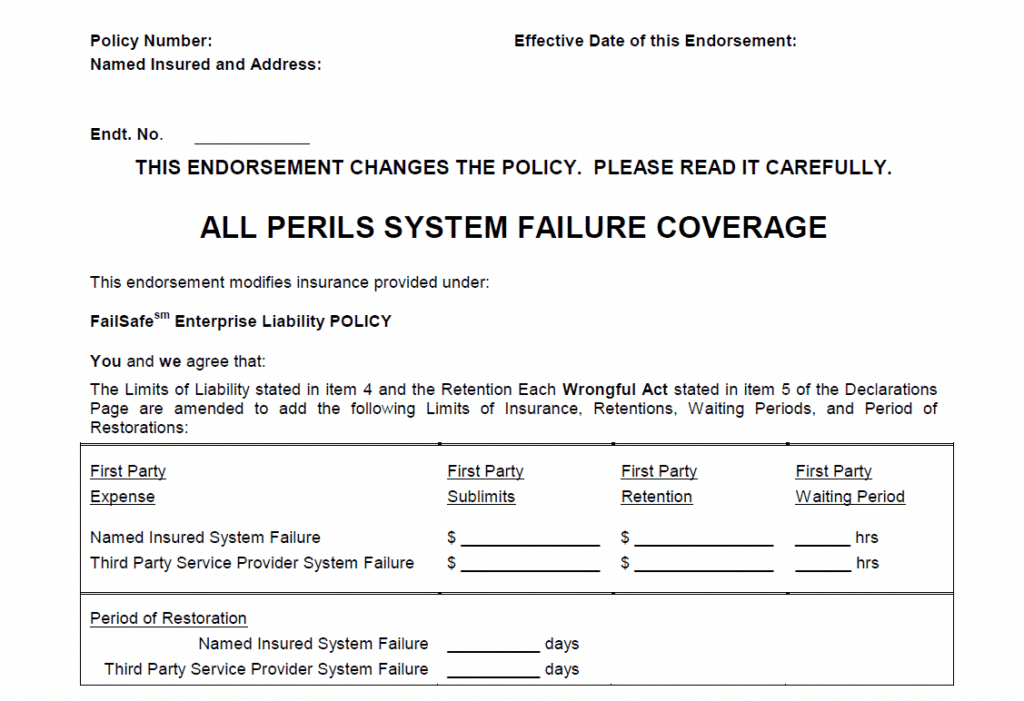
A sophisticated policy, like The Hartford’s FailSafe GIGA form, can be modified with specific broadening endorsements to provide true supply chain attack insurance.
1. The Problem: Your vendor’s failure shut your business down.
- The Endorsement: All Perils System Failure Coverage (Form FS 00 H368 00 1118)
- What It Does: Standard business interruption coverage often only pays if your own systems are hit by an attack. This endorsement broadens coverage to include lost income and extra expenses when a critical third-party provider’s system fails. If Cloudflare had to suspend its Salesforce use to stop data exfiltration, this is the endorsement that would reimburse them for the operational downtime.
2. The Problem: You had to proactively shut down your systems to prevent worse damage.
- The Endorsement: Voluntary Shutdown Coverage (Form FS 00 H370 00 0919)
- What It Does: In a crisis, the smartest move is often to take your own systems offline to contain a threat. Many policies won’t cover the resulting income loss. This endorsement treats an intentional shutdown made to mitigate a network intrusion as a covered “network outage” for business interruption purposes, rewarding a prudent and rapid response.
3. The Problem: Your contract forces you to pay for your client’s breach-related losses.
- The Endorsement: Affirmative Indemnification Clarification (Form FS 00 H034 00 0520)
- What It Does: Tech contracts are filled with indemnification clauses where you promise to cover a client’s losses. Many policies exclude this “assumed contractual liability.” This endorsement closes that dangerous gap, clarifying that the policy will cover damages you are obligated to pay under an indemnity agreement, ensuring your insurance backs up your contractual promises.
4. The Problem: You need to refund angry customers to maintain goodwill.
- The Endorsement: Return of Fees for Enterprise Services (Form FS 00 H372 00 0919)
- What It Does: After a breach, you may need to refund service fees. Standard policies exclude this as a business loss. This endorsement broadens the definition of “damages” to include fees you return to a client, subject to the insurer’s consent and a coinsurance requirement, allowing you to make customers whole without bearing the full financial brunt.
5. The Problem: Regulators are investigating, and legal bills are piling up.
- The Endorsement: Data Privacy: Laws, Regulatory Proceeding & Wrongful Act Redefined (Form FS 00 H033 00 0918)
- What It Does: A massive breach is guaranteed to attract regulators. This form modernizes your policy to explicitly cover formal regulatory proceedings and insurable fines under laws like GDPR. For a truly robust response, it should be paired with the Regulatory Inquiry endorsement (Form FS 00 H611 00 0919), which covers the legal expenses of responding to informal inquiries before they become a formal lawsuit.
The Final Verdict: Your Standard Policy Is Not Enough
The Cloudflare incident is a clear signal that supply-chain risk is one of the biggest threats facing businesses today. A simple cyber policy is no longer sufficient; what’s needed is dedicated supply chain attack insurance built from endorsements that cover third-party failures. Your financial lifeline depends on this fine print.
Your legacy broker likely sold you a standard policy without stress-testing it against a complex, multi-party claims scenario like this one. They may not even be aware of how these subtle differences in wording could leave your company exposed when a crisis hits.
PlausTech Can Help: Find Your Supply Chain Blind Spots Before an Attack Does
Standard cyber policies weren’t built for the domino effect of a supply chain attack, leaving you exposed. PlausTech is the AI-first brokerage that specializes in building true supply chain attack insurance programs designed for this new reality.
Our proprietary CoverageXpert database maps every critical endorsement—like the Hartford forms in this article—needed to cover third-party risk. We then use our CoverageLocator technology to stress-test your policy against real-world supply chain scenarios, pinpointing exactly where a vendor’s breach would leave you vulnerable.
Our platform ensures no gaps are missed and provides a crystal-clear roadmap to best-in-class protection.
Special Offer for Hartford Policyholders: If your company is insured under The Hartford FailSafe GIGA Enterprise policy, you can get a free, no-obligation policy review with PlausTech to ensure you have the endorsements discussed in this article.
Is Your Policy Ready for the Next Domino to Fall?
Don’t let a vendor’s mistake become your company’s financial catastrophe. A supply chain attack isn’t a matter of if, but when. Ensure your insurance is built for the reality of interconnected risk.